Exoplanet Science
Specialization in exoplanet science within the LMU Astrophysics MSc program

Specialization in exoplanet science within the LMU Astrophysics MSc program
Exoplanets are planets found beyond our Solar System, orbiting other stars. Since the discovery of the first exoplanet in 1995, exoplanet science has become one of the fastest growing subdisciplines of astronomy and astrophysics.
The LMU Faculty of Physics and Faculty of Geosciences, supported by the Munich Center for Geoastronomy, offer an Exoplanet Science specialization within the four-semester Master of Science in Astrophysics. As part of this initiative, you will receive a comprehensive education that combines solid astrophysics training with specialized training in exoplanet science, planetary science, and the geosciences. This interdisciplinary approach will provide you with a unified and specialized understanding of the tools, techniques, and methods necessary to address questions in both astrophysics and exoplanet science.
Outcome: You graduate with an LMU MSc degree in Astrophysics plus an official Exoplanet Science specialization certificate noted by the Examination Office.
Who is it for? Motivated MSc Astrophysics students who want to receive interdisciplinary training in exoplanet science and its cutting-edge frontiers beyond the classical astrophysics curriculum – to tackle complex problems in the field and excel in a variety of settings.
1) Students have to select all the mandatory modules of the Master Astrophysics program (P1, P2, P3) and one Lecture of their choice in Modern Physics (WP 1-14).
2) Within the framework of the Elective Astrophysics Courses in the MSc Astrophysics program students have to select all mandatory components below (totaling 30 ECTS) for the Exoplanet Science specialization *:
3) Within the framework of the Elective Lecture in the MSc Astrophysics program students have to select one of the offered Elective Lectures below (6 ECTS) as the elective component of the Exoplanet Science specialization*:
4) The Research Project Modules (WP 36/37 and WP 38/39) as well as the final Master Thesis (WP 40/41) also form mandatory components of the Specialization and have to be completed with a focus on Exoplanet Science* (your supervisor confirms eligibility when you register your thesis)
*Please see the detailed list of all mandatory and elective components of the specialization under ‘Program Structure’. Please also make note of courses which are offered only in specific semesters.
Note: The requirements for the specialization are in addition and complementary to the mandatory requirements of the Master of Astrophysics curriculum. If you fulfill both sets of requirements by the end of your studies, you will get the MSc Astrophysics degree with a specialization certificate in Exoplanet Science. If not, you can obtain the regular MSc Astrophysics degree certificate.
The program structure (PDF, 423 KB) includes the list of all mandatory and elective components of the Exoplanet Science Specialization, as well as links and guide for registering and implementing a Master's thesis as per regulations applicable to the MSc Astrophysics Program.
Detailed information about the Master of Astrophysics curriculum and regulations can be found here under ‘Curriculum details’ and ‘Links & Downloads’. The Examination Office issues the certificate once all requirements are met.
This curriculum outline integrates the requirements of the Master of Astrophysics curriculum and of the Exoplanet Science Specialization Certificate.
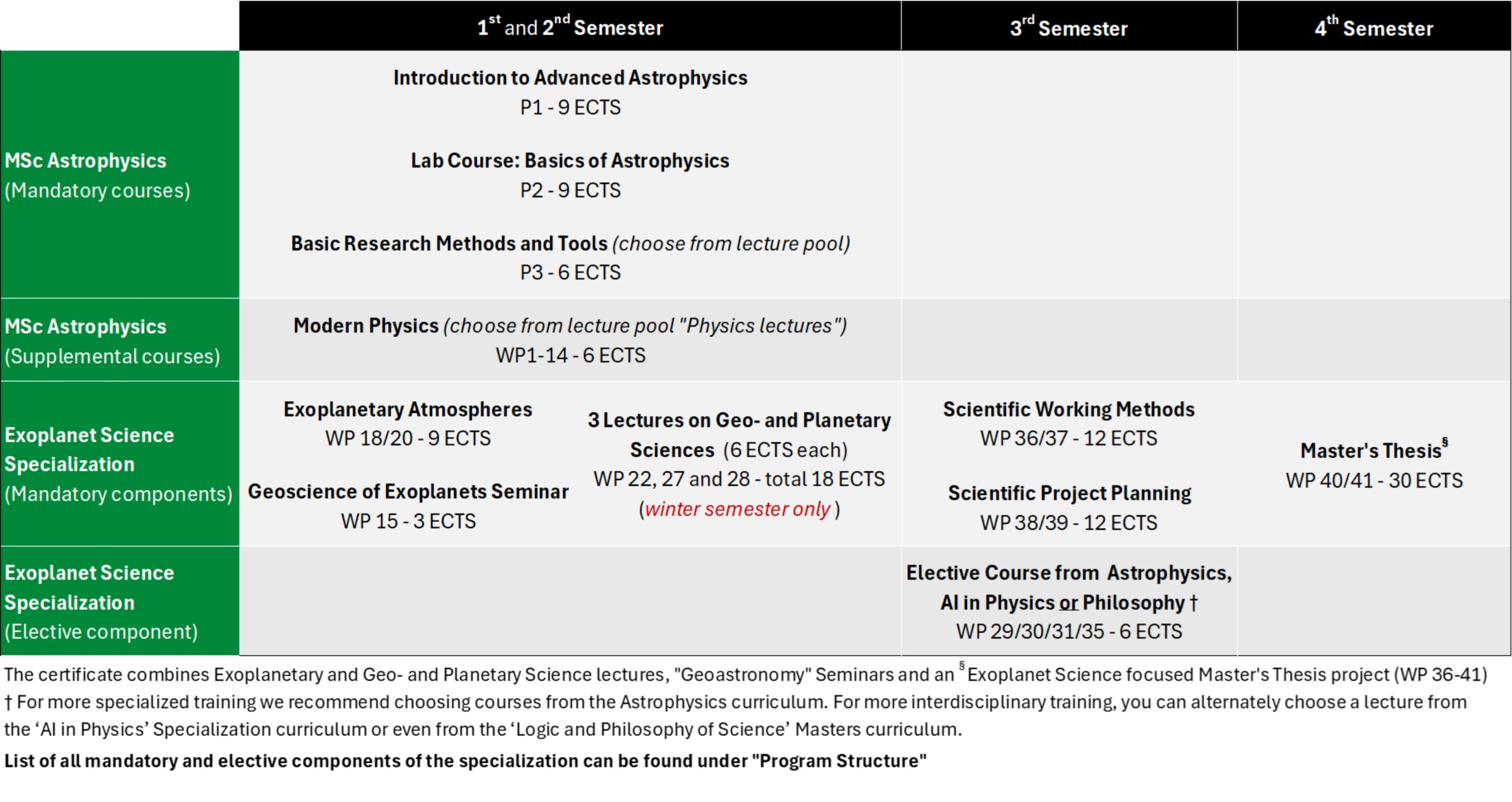
To get an idea of how your courses could be planned, please have a look at our exemplary schedule (PDF, 144 KB).
*Please see the detailed list of all mandatory and elective components of the specialization under ‘Program Structure’
Tip: Please plan your course registrations early. Some courses have application windows or moodle sign-ups, and most courses are offered only in specific semesters, not every semester.
This specialization reflects the growing need for an interdisciplinary approach to exoplanet science – a field that demands expertise beyond traditional astrophysics. We are committed to the interdisciplinary training of the next generation of students who develop critical and creative problem-solving skills, to drive future discoveries and innovations.
Research & PhD: in Exoplanet Science or a related field to conduct academic research at universities, research institutions, or observatories, or at laboratories and government agencies nationally and internationally.
Industry & labs: focused on space technology, planetary sciences, education and outreach etc.
Kindly go through the provided information on this page, as well as detailed information on the MSc Astrophysics page (including Examination and study regulations under Links & Downloads, and Curriculum details) + the Applying to a Master's program pageat the Faculty of Physics.
For any organizational questions (registrations, course planning etc.) please contact Dr. J. Jaiswal.
For any remaining questions regarding the curriculum content, please contact Prof. Dr. Kevin Heng.